
This year represents Diaspora Vibe Cultural Arts Incubator’s tenth year of International Cultural Exchange. Conceived by Gallery Founder and Director Rosie Gordon-Wallace, the cultural arts exchange is an innovative program that brings together artists, curators, writers and cultural workers to engage in a rigorous program of exchange, exhibition, studio visits and workshop intensives in the Caribbean Diaspora and beyond. The theme of this year’s exchange is ‘Living Sculpture’. Artists have been invited to Jamaica to explore and engage sculpture, performance, installation and site-specific works that consider the significance of the body in both the creation and the content of the art, as well as the importance of public art as a means of engaging community and defining the language of a culture.
Participating artists, writers, curators, and culture-makers represent an incredible range of cultural backgrounds, nationalities, homelands and artistic practices. And the rollcall:
Carlos Alejandro, Artist
Jacquenette Arnette, Artist
Carol Campbell, Director/Curator, Revolution Gallery
Margaret Chen, Faculty, Sculpture, Edna Manley College of the Visual and Performing Arts
Jean Chiang, Artist
Rozi Chung, Faculty, Edna Manley College of the Visual and Performing Arts
Alejandro Contreras, Artist
Israel Delmonte, Faculty, Edna Manley College of the Visual and Performing Arts
Lorna Dunkley, Arts Event Coordinator
Ermán, Artist
Stella Gonzalez, Artist Coordinator
Rosie Gordon-Wallace, Director/Curator, Diaspora Vibe Cultural Arts Incubator
Annie Hamilton, Dean, Edna Manley College of the Visual and Performing Arts
Marlon Hill, Esq, Featured Presenter
Deborah Jack, Artist
Rodney Jackson, Artist
Benari Kamau, Artist
Pat Kendrick, Faculty, Edna Manley College of the Visual and Performing Arts
Aaron Ledos, Artist
Jenni Lewin-Turner, Urban Cultural Scholar
Petrona Morrison, Director, Edna Manley College of the Visual and Performing Arts
Gordon Myers, Musician
Nishan, Artist
Wura-Natasha Ogunji, Artist
Veerle Poupeye, Curator, Art Historian
Danny Ramirez, Artist
Michelle Ramlagan, PhD, Scholar
Patricia Roldan, Artist
Marie Segree, Artist
Omar Tavares, Artist
Roy Wallace, Installation Designer
Indygo Williams, Photographer
Director Rosie Gordon-Wallace has described the exchange as an opportunity ‘to have a conversation with ourselves, about ourselves.’ The ICE program interprets the ‘ourselves’ in the most expansive way, engaging the concept of ‘diaspora’ as a way to understand and dialogue about the deeply creative and innovative ways that we approach artmaking, culture and community engagement.
Photo Gallery and Diasporic Journal: Day One: April 2nd

A moment to savor: the safe arrival of the art

Kingston welcomes us

Otaheite Apples for the seaside ride, courtesy of Lorna Dunkley, Arts Event Coordinator

The beautiful, brilliant Rosie Gordon-Wallace

We arrive at Revolution Gallery.
Revolution Gallery is located in a beautiful great house that has been converted into a gallery. Sculptural works greet visitors as they enter the exhibition space.

Jamaican Breakfast at Revolution Gallery, hosted by Director Carol Campbell
Next, we depart for Edna Manley College of the Visual and Performing Arts, a host site for the International Cultural Exchange. The afternoon is filled with studio visits and classroom dialogues.

Public art graces the architecture, by Stefan Clarke, Sculptor and Edna Manley Graduate

Sculpture by Warren Buckle, Edna Manley College of the Visual and Performing Arts
We were moved and honored to visit the studio of fourth-year student and Sculptor, Warren Buckle. His large-scale hanging metal sculptures suggest the delicacy of the natural world and the enormity of a science fiction film. This work hung gracefully in the space. We are strategizing a way to bring it back to Miami for exhibition. Perhaps the work will fly its way there.

(l to r) Michelle, Rodney, Stefan Clarke, Rosie, Erman, Patricia and Warren Buckle, Sculptor, Edna Manley College of the Visual and Performing Arts
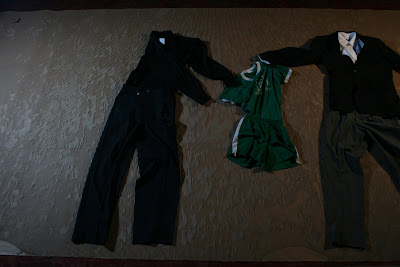
animation still, by Kemar Swaby, Artist, Edna Manley College of the Visual and Performing Arts
We visited with students including artist Kemar Swaby. Swaby animates articles of clothing to create a narrative that explores issues of sex, sexuality and abuses of power. His vignette of a disturbing encounter between two suits and a soccer player’s uniform is a meditation on the violence that is hidden by and between societal lines of class. His eloquent sense of rhythm in this work will surely develop as an integral part of his visual vocabulary in the years to come.

Ebony Disciplez (Rayo) by Ebony G. Patterson
The CAGe (College of Arts Gallery) featured Ebony G. Patterson's mixed media installation entitled 'Gangstas, Disciplez +the Doiley Boyz'. This gorgeous suite of works explores the aesthetics and attitudes of urban dancehall culture, embedded with hyperbolized narratives of male sexuality, both hardcore and skin-bleached. Patterson, a graduate of Edna Manley, pushes boundaries of site, space and gender in her poetic-ly sparkled and saturated and doiley-decorated rooms.
***
Join us on Friday, April 3rd from 7-10pm for the opening reception of ‘Living Sculpture’
Revolution Gallery
44 Lady Musgrave Road
Kingston 5, Jamaica WI
Exhibition Dates: April 2-6, 2009
Enjoy refreshments, performances and live music.
***


 Beverly Anderson Manley, former First Lady of Jamaica
 Beverly Anderson Manley, former First Lady of Jamaica
 Norma Harrack, Ceramicist, Faculty Edna Manley College with Rosie Gordon-Wallace
 works by Ermán
 Ricardo Allicock, former Consul-General to the Southern United States
 Eglantine Buchanan Gordon and Ronald Horsham
 Carol and Diane
 Mazola wa Mwashigadi speaks about his installation at the reception
 Mazola wa Mwashigadi's outdoor installation
 Musician Gordon Myers
 Jean Chiang in front of her work
 Petrona Morrison and Rodney Jackson
 Rosie Gordon-Wallace and Urban Culturalist Jenni Lewin-Turner
 Jacquenette Arnette
 Ermán
Ermán  Danny Ramirez, Marie Segree
 Lisa Lindo, Garfield Morgan and Shelley Ann McFarlane
 Benari Kamau's painting
 Marie Segree in front of her installation
 Rosie Gordon-Wallace and Wura-Natasha Ogunji
 Rosie Gordon-Wallace, Norma Harrack, Ceramicist, Nicole Winter, Ceramicist, David Dunn, Ceramicist and Faculty, Edna Manley College
 Hope Brooks, Artist and Vice Principal Academic and Technical Studies
 Gilou Bauer and Rosie Gordon-Wallace
 Eglantine Buchanan Gordon presents Edna Manley College student and ceramicist, Nicole Winter with the inaugural 'Eglantine Buchanan Gordon Scholarship for Excellence in the Arts'.
 Rosie Gordon-Wallace, Petrona Morrison, Annie Hamilton
 Photographer Indygo Williams


